AI agents discover products through citations and complete carts through Storefront APIs—not the same checklist. Use this merchant admin audit for schema, endpoints, bot access, and checkout friction before agent traffic scales.
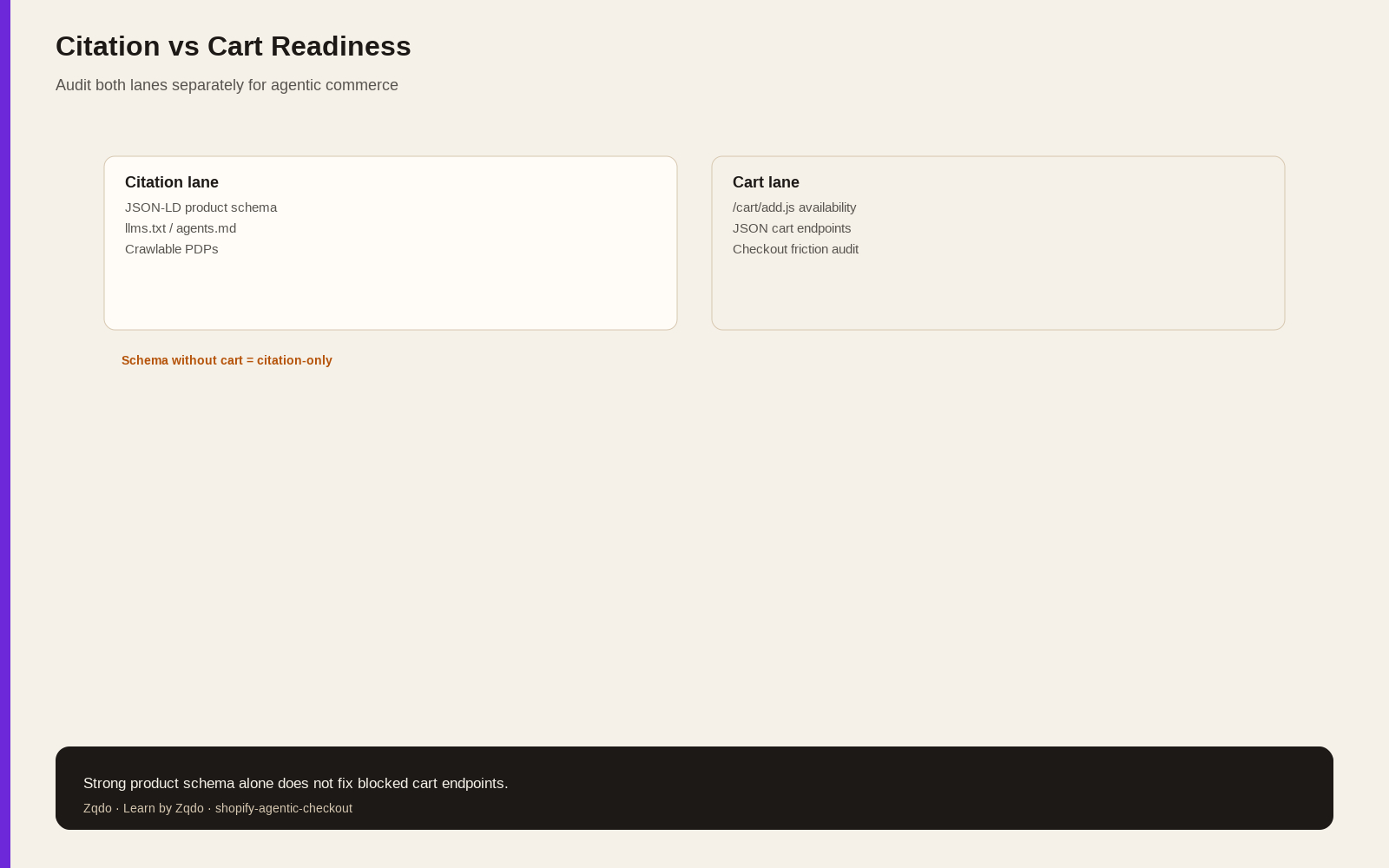
Agentic checkout readiness on Shopify splits into two lanes: citation readiness (structured product data, llms.txt, crawlable PDPs so AI systems can recommend your SKUs) and cart readiness (public product JSON, /cart/add.js without bot challenges, headless-friendly checkout, real-time inventory in schema). Audit robots.txt and WAF rules for OAI-SearchBot and ChatGPT-User. This checklist covers standard B2C storefronts—not B2B company catalogs, draft orders, or wholesale-only flows.
Why Split Citation Readiness From Cart Readiness?
Merchants hear 'AI checkout' and jump to schema markup. That fixes half the problem. AI systems cite products from crawlable, structured PDPs—but completing a purchase requires cart endpoints, inventory truth, and checkout steps an agent can execute without a human browser session.
Citation readiness answers: 'Can an AI accurately recommend this SKU with the right price, variant, and URL?' Cart readiness answers: 'Can an automated client add that variant and reach a payable checkout?' Strong AEO without cart access produces referrals that stall at step five.
Lane
What agents need
Common failure
Citation
Product + Offer JSON-LD, stable URLs, llms.txt
Price only in JavaScript, no Offer url
Citation
Clean H1, variant labels in HTML
Variants rendered only after client-side fetch
Cart
/products/[handle].json returns 200
Theme or WAF blocks JSON endpoint
Cart
POST /cart/add.js returns JSON
CAPTCHA or bot challenge on /cart/*
Cart
Checkout reachable with cart token
Forced login before cart, broken multipass
Strong product schema alone does not fix blocked cart endpoints—audit citation and cart lanes separately.
What Belongs on the Merchant Admin Checklist?
Work top-down from revenue SKUs. Eighty percent of agent failures cluster on a small set of hero products with complex variants or apps layered on the PDP.
Discovery and crawl policy
robots.txt allows product, collection, and policy URLs agents need to cite.
Explicit allow rules for target agent user agents where your CDN supports them.
llms.txt or equivalent discovery file lists canonical paths—see the Shopify llms.txt guide.
No accidental noindex on money PDPs after theme or app updates.
Structured product data
Product and Offer JSON-LD on every hero PDP with price, currency, availability, and url.
Variant SKUs and option values match what /products/[handle].json returns.
Organization schema with consistent brand name across market domains.
Validate in Rich Results Test after every major theme or app change.
For the broader answer-engine strategy—FAQ blocks, speakable summaries, and AI citation patterns—see the Shopify AEO guide. This checklist assumes you want agents to both cite and buy, not just appear in summaries.
Cart and API surfaces
From a third-party IP, GET /products/{top-handle}.json — expect 200 with variant IDs and inventory.
POST /cart/add.js with a valid variant ID and agent-like user agent — expect JSON, not HTML interstitial.
Confirm inventory in schema or JSON updates within minutes of a stockout, not nightly sync.
Storefront API access enabled where your integration roadmap needs headless cart creation.
Checkout friction audit
Guest checkout available for standard B2C orders.
No mandatory account creation before cart review.
Age gates and regional locks documented—agents cannot click through opaque modals.
Required line-item properties and cart attributes documented; agents need machine-readable names.
Express wallets (Shop Pay, Apple Pay, Google Pay) do not replace fixing broken standard checkout for agents.
Checkout Extensibility migration can remove legacy scripts that agents relied on—or add UI extensions agents cannot see. Align this audit with the Shopify checkout extensibility guide if you are mid-migration.
What Is Out of Scope for This Checklist?
This guide targets standard B2C Shopify storefronts. Exclude these paths from the checklist—they need different playbooks:
B2B company accounts, shared carts, and catalog permissions.
Wholesale-only SKUs hidden from the Online Store channel.
Draft orders, invoicing, and net-term workflows.
Custom Plus checkout Functions that change price or cart shape at runtime without API equivalents.
If your business is primarily B2B, start with the Shopify B2B catalog vs wholesale apps guide for catalog architecture—then return here only for the consumer-facing storefront that agents can actually reach.
How Do You Run a Two-Week Agentic Readiness Sprint?
Treat agent readiness like a release gate, not a one-time SEO task.
Week 1 days 1–2: pick top 10 SKUs by revenue; export variant IDs and current schema.
Week 1 days 3–4: run citation audit—JSON-LD, HTML source, llms.txt links.
Week 1 day 5: run cart audit—JSON endpoint and /cart/add.js from external IP.
Week 2 days 1–2: fix schema and JSON mismatches first.
Week 2 days 3–4: fix WAF and bot rules on /cart/* and /products/*.json.
Week 2 day 5: re-test full add-to-cart path; log user agent and response codes.
How Do You Monitor After Launch?
Server or CDN logs filtered by known agent user agents—weekly review.
404 and 403 spikes on /products/*.json and /cart/add.js.
Conversion rate on AI-referred landing URLs vs sitewide baseline.
Quarterly re-audit when installing apps that touch PDPs, carts, or checkout.
When Should You Bring in Help?
Merchants can fix robots.txt, basic schema gaps, and guest-checkout settings without an agency. Bring in SEO and Shopify development when WAF rules block cart endpoints, variant data lives only in app widgets, checkout extensibility removed agent-safe paths, or citation and cart audits disagree on price and inventory.
Zqdo's Perspective
Zqdo treats agentic checkout as AEO plus infrastructure—not a single plugin. Our audits split citation work (schema, llms.txt, PDP structure) from cart work (endpoints, bot policy, checkout friction) because marketing teams own the first and development owns the second. The merchants who lose agent sales usually pass the Rich Results Test and fail a curl to /cart/add.js. We scope B2C storefronts explicitly; B2B catalog complexity belongs in a different conversation. Re-test hero SKUs monthly—agent platforms move faster than your annual theme refresh.
Key Takeaways
✓Citation readiness and cart completion readiness are different audits—strong schema alone does not fix blocked /cart/add.js.
✓Agents read Product and Offer JSON-LD, product JSON endpoints, and llms.txt-style discovery files—not theme JavaScript alone.
✓WAF and bot challenges on /cart/* silently break agent checkouts that work fine in your browser session.
✓Forced account creation, age gates, and required custom fields are high-friction failure points for automated buyers.
✓B2B-only catalogs, company permissions, and wholesale checkout paths are out of scope for this B2C checklist.
✓Re-test top revenue SKUs monthly; agent user agents and platform policies change faster than theme releases.
Frequently Asked Questions
What is agentic checkout on Shopify?+
Agentic checkout is when an AI assistant or autonomous agent discovers a product, builds a cart, and completes or hands off purchase steps on behalf of a shopper. On Shopify this usually combines crawlable product data, Storefront API or cart endpoints, and a checkout flow that does not require fragile browser-only interactions.
What is the difference between citation readiness and cart readiness?+
Citation readiness means AI systems can accurately describe and link to your products—JSON-LD, clean PDP HTML, llms.txt, and consistent URLs. Cart readiness means an agent can add variants to cart and reach checkout without CAPTCHA, WAF blocks, or missing JSON endpoints. You can rank in AI answers and still fail at purchase.
Do I need Shopify Plus for agentic checkout?+
No for core B2C readiness. Plus helps when checkout customizations must be rebuilt on Checkout Extensibility, but schema, product JSON, cart endpoints, and bot allowlists are plan-agnostic concerns on standard storefronts.
Which bots should I allow in robots.txt?+
Confirm current agent documentation for your target platforms. Common starting points include OAI-SearchBot, ChatGPT-User, GPTBot, PerplexityBot, and ClaudeBot—allow crawl paths to products and policies, and mirror those allowances in CDN or WAF rules so /cart/* is not challenged.
Does this checklist cover Shopify B2B checkout?+
No. B2B company accounts, catalog permissions, quantity rules, and draft-order workflows need a separate audit. This guide is for standard consumer storefronts where agents add variants and proceed through public checkout.
Continue Learning
Related guides, real Zqdo project examples, and the category hub for deeper exploration.
David Frempong is the founder and digital consultant at Zqdo. He is a hands-on web developer and Shopify developer who helps ecommerce brands and local businesses improve their websites, integrations, SEO, AEO, analytics, and conversion performance.